Binance offers 23 networks for withdrawing USDC, and the USDC contract it uses on BSC doesn't appear on the list of mainnet USDC contracts that Circle publishes. It carries the same name as USDC on Ethereum, Arbitrum and Base, but on-chain it is a separate contract.
Same name, two different contracts
Both are called USDC, but the contract Binance uses on its BSC network has 18 decimals, while USDC on Ethereum, Polygon, Arbitrum and Base has 6. Those are the values each contract's decimals() function returns, and you can read them on the contract's page in a block explorer. name() returns USD Coin for all five, so the name alone won't tell you which one you're looking at.
There's a second thing. Circle's developer documentation has a page, "USDC contract addresses," that lists its USDC contract on each mainnet. Ethereum 0xA0b8…eB48, Polygon PoS 0x3c49…3359, Arbitrum 0xaf88…5831, Base 0x8335…2913, OP Mainnet 0x0b2C…Ff85 and Solana EPjF…Dt1v each match the contract address Binance lists for that network. BNB Smart Chain is not on this mainnet list, and the contract Binance uses for BSC, 0x8ac76a51cc950d9822d68b83fe1ad97b32cd580d, is nowhere on the page.
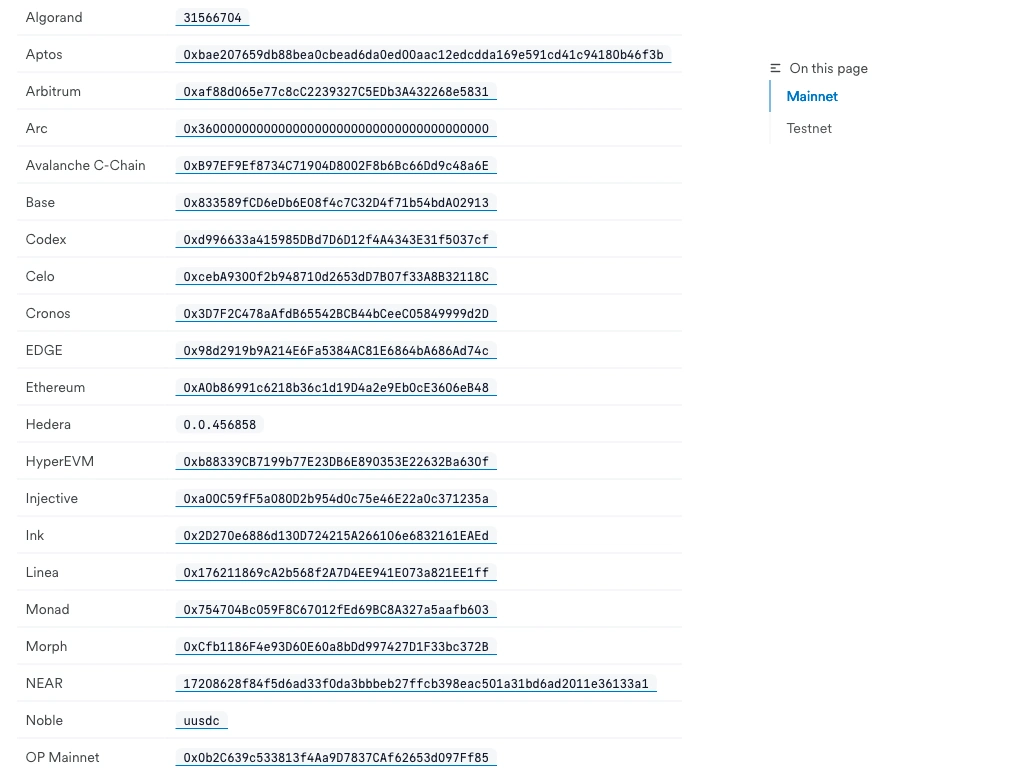
0xaf88d065e77c8cC2239327C5EDb3A432268e5831 and the Ethereum row 0xA0b86991c6218b36c1d19D4a2e9Eb0cE3606eB48. No BNB Smart Chain row follows Avalanche C-Chain and Base.Together, the two facts leave only one conclusion: this USDC on BSC and the native USDC on Circle's list are two different contracts. Leaving aside how each one is issued and redeemed, the part that affects a transfer is this: if the recipient only accepts Circle's native version, don't send from BSC.
One chain can also carry two kinds of USDC at once. In its entry for X Layer, Circle's page says: "X Layer also has a separate bridged USDC representation, labeled USDC.e, which is not issued or backed by Circle." So asking whether a chain has USDC isn't enough. You need to know which contract the recipient accepts.
Binance USDC withdrawal networks compared (as of 2026-09-23)
The figures come from the public coin and network configuration behind Binance's withdrawal page, as it stood on 2026-09-23. To check them yourself, log in, choose USDC on the Binance withdrawal page and expand the network list: each network shows its minimum withdrawal and its fee. You can also compare them with Binance's public crypto deposit and withdrawal fee page. The numbers can change at any time, so trust the withdrawal page over this table. On that date Binance had 23 networks configured for USDC. The table lists 11 commonly used ones; the other 12 are ARC, Algorand, Asset Hub Polkadot, CELO, NEAR, Ronin, SEIEVM, Sonic, Starknet, Sui, World Chain and zkSync Era. Minimum withdrawals and fees are in USDC.
| Network | Minimum withdrawal | Withdrawal fee | Confirmations to credit a deposit | Deposits / withdrawals | Contract vs Circle's mainnet list |
|---|---|---|---|---|---|
| BNB Smart Chain (BEP20) | 3 | 0 | 1 | Open / Open | Not on the list |
| Ethereum (ERC20) | 5 | 0.6 | 6 | Open / Open | Matches |
| Solana | 3 | 0.3 | 1 | Open / Open | Matches |
| Arbitrum One | 3 | 0.2 | 120 | Open / Open | Matches |
| Base | 3 | 0.2 | 1 | Open / Open | Matches |
| Polygon POS | 3 | 0.12 | 200 | Open / Open | Matches |
| Optimism | 5 | 0.05 | 25 | Open / Open | Matches |
| Aptos | 5 | 0.04 | 1 | Open / Open | Matches |
| Stellar Network | 2 | 1 | 1 | Open / Open | Matches |
| AVAX C-Chain | 5 | 0.056 | 12 | Closed / Closed | Matches |
| Hedera Hashgraph | 5 | 0.1 | 1 | Open / Closed | No contract in Binance's configuration; not compared |
The deposit confirmations column is the number of blocks Binance waits for when someone deposits USDC to Binance. When you withdraw from Binance, how many blocks the recipient waits before crediting you depends on the recipient's own rules. Block counts don't convert to minutes either: chains produce blocks at different speeds, so Arbitrum's 120 and Ethereum's 6 can't be set side by side to see which arrives first. If the term is new to you, start with how a confirmation count works.
On that day AVAX C-Chain had both deposits and withdrawals closed, and Hedera allowed deposits but not withdrawals. A closed network can't be selected on the withdrawal page, and the only way to know when it reopens is to check the page again.
BSC has the lowest fee, and it's the one to ask the recipient about
BSC is the cheapest row in the table: a fee of 0 and a minimum of 3 USDC. Ranked by fee, it comes first. Ranked by whether the other side will accept it, it's the network you most need to ask about.
The reason is in the first section. It isn't on Circle's mainnet list and isn't the same contract as native USDC. If the recipient is another platform, its USDC deposit page may or may not list BSC, and if it does, you still need to check that the contract address it gives is this one, 0x8ac7…580d. If you send over BSC when it isn't listed, you've used the wrong network. Whether funds sent on the wrong network come back then depends on whether that platform is willing to handle it.
The other networks have quirks of their own. Optimism charges 0.05 but has a minimum of 5. Stellar's minimum is only 2, yet its fee of 1 is the highest of the 11. The cheapest network also changes with the amount. Withdraw just 3 USDC and you're below the minimum on Optimism, Aptos and Ethereum, so the cheapest option after BSC is Polygon at 0.12. For a 3,000 USDC withdrawal it becomes Aptos at 0.04. All of that still ranks below whether the recipient accepts the network: saving a fraction of a USDC isn't worth having the money stuck on the other side. A broader comparison of withdrawal fees by network shows how these fee tiers usually line up, and USDT comes with its own choice between TRC20, ERC20 and BEP20.
Pick the network by who's receiving
- The recipient is another exchange. Open its USDC deposit page and see which networks it lists. If the page gives a contract address, copy the whole string and search for it on Circle's page rather than comparing only the first and last few characters. Among the networks both sides support with matching contracts, pick the one with the lower fee.
- The recipient is your own wallet. Decide first which chain you'll use this USDC on afterwards. Addresses on Ethereum, BSC, Arbitrum, Base, Polygon and Optimism all share the same
0xformat, so the address won't tell you which network to use, and the coins stay on whichever chain you send them to. Withdraw on the network whose USDC the app you plan to use recognizes. - The recipient is a person or merchant who sent you payment details. If they named a network, use it. If they wrote only USDC with no network, ask before you send; don't pick the cheapest yourself. If they want ERC20, the 0.6 fee is simply the cost of this transfer.
- The recipient says it accepts only Circle's native USDC. Choose from the rows marked Matches that had withdrawals open that day. BSC isn't a candidate.
If you're unsure, run both sides through the Network Picker to see which networks they share, then go through the Pre-Transfer Checklist before you send.
Before you send
The name is USD Coin everywhere, and the decimals can match too: Circle's native USDC has 6 on both Ethereum and Arbitrum, yet the addresses differ and you still can't send straight from one chain to the other. The things that tell them apart are the contract address and whether it's on Circle's list. Choosing a network means choosing the one contract, on the one chain, that the recipient accepts.
The fees, minimums and open or closed status in the table record a single day, 2026-09-23. A few months on, some networks may have changed their fees or closed, and new ones may have been added.
The first time you send USDC to a new address or over a new network, send a small amount first and send the rest once it arrives. One extra fee confirms that the recipient really can receive this contract on this chain.
Frequently asked questions
What is USDC.e?
In the X Layer entry of Circle's documentation, USDC.e is the bridged version brought over from elsewhere. Circle's wording is "X Layer also has a separate bridged USDC representation, labeled USDC.e, which is not issued or backed by Circle." The two have different contract addresses and can exist on the same chain at once. Which one a recipient accepts is shown by the contract address on its deposit page.
Can I send USDC on BSC straight to an Ethereum wallet?
It won't change chains. Coins sent over the BSC network land at that address on BSC and don't show up in its balance on Ethereum, and the USDC on the two chains are different contracts as well. If the 0x address is an exchange deposit address and that exchange doesn't accept BSC deposits, you've sent on the wrong network.
Why can't I select some USDC networks on Binance?
The platform switches deposits and withdrawals on and off for each network separately. On 2026-09-23, AVAX C-Chain had both deposits and withdrawals closed and Hedera Hashgraph had only withdrawals closed. These switches change, and a network you can't select on the withdrawal page was simply closed at that moment.